Call immediately - do NOT wait for symptoms to appear. Hypoglycaemia can occur within 30 minutes.
Xylitol in Strawberry-Flavoured Products: The Complete Dog-Safety Guide
Fresh strawberries are safe for dogs. Strawberry-flavoured yoghurt, jam, ice cream, gum, toothpaste and other processed products may not be, because sugar-free and sugar-reduced versions of them can be sweetened with xylitol. This page is the cluster-canonical xylitol reference. It is linked from our sister sites on apples, grapes, and watermelon because xylitol appears in flavoured variants of all of them.
Quick Answers by Product
Short verdicts on the most-asked strawberry-product questions. These are the same six answers carried in this page's FAQ, and the underlying rule for all of them is the same: read the ingredient panel on the pack in your hand.
Can dogs eat strawberry jam?
No, not really.
Regular full-sugar strawberry jam is not toxic, but the sugar load (50-65g per 100g) makes it inappropriate to share. The variants to worry about are the sugar-free, 'no sugar added' and 'diabetic-friendly' ones, because that is the category where a sugar alcohol replaces the sugar. Read the ingredient panel every time.
Can dogs eat strawberry yogurt?
Only plain, unsweetened.
Strawberry-flavoured yoghurt deserves extra care because the sugar-reduced variants (light, reduced sugar, zero sugar, keto, high protein) are the ones sweetened with sugar alcohols. No register of which tubs contain xylitol exists, so the panel on the tub in your hand is the only reliable check. Plain full-fat yoghurt with fresh strawberry pieces avoids the question entirely.
Can dogs eat strawberry jelly?
No.
Strawberry jelly (US 'jelly' meaning seedless preserve, or UK 'jelly' meaning fruit-set dessert) sits in the same sugar-free category risk as jam, and the standard versions are very high in sugar. Not appropriate for dogs either way.
Can dogs eat strawberry pop tarts?
No.
Frosted Strawberry Pop-Tarts list corn syrup, high-fructose corn syrup, dextrose and sugar, with no xylitol or other sugar alcohol on the panel, as published on Kellogg's SmartLabel listing and checked 7 September 2026. The problem with them is the sugar, fat and refined grain rather than xylitol. A homemade 'sugar-free' or keto copycat is a different question, so check that recipe.
Can dogs eat strawberry applesauce?
Plain only.
Plain strawberry applesauce with no added sweeteners is generally safe in small amounts. With a 'no sugar added' variant, read the ingredient panel before sharing: that is the category where a sugar alcohol may have replaced the sugar. Watch the sugar content even in unsweetened versions, and keep portions small.
Can dogs eat strawberry ice cream?
No.
Regular strawberry ice cream is a lactose and sugar problem rather than a xylitol one. Halo Top Strawberry, the best known of the light versions, lists erythritol and not xylitol on its own ingredient page, checked 7 September 2026 - but that is one product on one date, and it is still not a dog food. Use a homemade pupsicle instead.
What Is Xylitol?
Xylitol is a sugar alcohol (a type of carbohydrate) that occurs naturally in small quantities in some fruits and vegetables. It is widely used as a sugar substitute because it has about 40% fewer calories than table sugar, does not spike blood glucose in humans, and has cavity-preventing properties that make it attractive for dental products.
In humans, xylitol is safe and even beneficial. In dogs, it triggers a catastrophic and completely different biological response. This is one of the most dangerous food-related toxins for dogs precisely because it is safe for humans - there is no reason for most people to suspect that a human product harmless to them could be deadly to their pet.
Where You Find It
- Sugar-free, "no sugar added", "light", "diet", "zero sugar" products
- Keto and low-carb products
- Diabetic-friendly foods
- Dental products (toothpaste, mouthwash, floss)
- Some "natural" or "health food" brands
- Some vitamins and supplements
- Some medications and liquid formulations
Hidden Names for Xylitol
*"Sugar alcohol blend" without specifying which sugars must be treated as a xylitol risk until proven otherwise.
Why Xylitol Is Highly Toxic to Dogs: The Mechanism
When dogs ingest xylitol, their bodies mistake it for glucose and trigger a rapid, massive release of insulin from the pancreas. In humans, xylitol does not trigger this insulin response (which is why it is safe for humans with diabetes). In dogs, the biological signalling pathway responds to xylitol as if it were real sugar.
This inappropriate insulin surge rapidly removes glucose from the bloodstream, causing severe hypoglycaemia (low blood sugar) within 30-60 minutes of ingestion. At higher doses, xylitol also directly damages liver cells, causing acute liver failure within 24-72 hours.
Toxicity Thresholds
MSD Veterinary Manual: "Doses of xylitol greater than approximately 100 mg/kg (45 mg/lb) have been associated with hypoglycemia in dogs." and "Some dogs ingesting xylitol at doses > 500 mg/kg (227 mg/lb) may develop severe hepatic insufficiency or failure." Xylitol Toxicosis in Dogs, checked 7 September 2026. The same two figures are published independently by the American College of Veterinary Pharmacists. These are onset points reported in dogs, not safe-dose points, and individual sensitivity varies.
Xylitol Content: What Is Actually Published
Gum: American College of Veterinary Pharmacists, "Gums usually contain 300 - 2000 mg of xylitol per piece." Baking: same source, "For powdered xylitol and home-baked goods 1 cup of xylitol weighs approximately 190 grams." Survived dose: Schmid and Hovda 2016. All checked 7 September 2026.
Why this list is short. On 7 September 2026 we removed figures for breath mints, "light" yoghurt, protein bars, toothpaste tubes and "no sugar added" jam. They were printed as point ranges and labelled "estimates from publicly available data", and no manufacturer listing or veterinary reference publishes a quantity for any of them. A made-up milligram figure in a poisoning calculator is worse than no figure, so they are gone rather than hedged. For anything not listed above, tell poison control what the product was and how much of it went in, and let them work the dose.
Real-World Example: Small Dog and Gum
A 5 kg dog reaches the 100 mg/kg hypoglycaemia threshold at 0.5 g of xylitol and the 500 mg/kg liver threshold at 2.5 g. The American College of Veterinary Pharmacists puts a piece of sugar-free gum at 300 to 2,000 mg (0.3 to 2.0 g) per piece. So a single piece can carry the hypoglycaemia dose for a toy breed on its own, and at the top of that published range four or five pieces reach the liver-failure dose. You cannot tell from looking which end of the range a given piece sits at: content varies by brand and by flavour within a brand. Gum falls out of handbags, dogs find it, and this is why gum is the exposure veterinary practices see most.
Xylitol Risk Calculator
Enter your dog's weight and the estimated xylitol consumed to assess the risk level. This is a screening tool only - always call poison control regardless of the result.
The estimated dose is below the published 100 mg/kg threshold, but this band is our own precaution rather than a published figure. It exists because the amount actually eaten is nearly always a guess and because xylitol content varies by brand and by flavour within a brand.
Call poison control for professional assessment. Keep poison control numbers ready.
This calculator is a screening tool only. It does nothing but divide the grams you enter by your dog's weight and compare the result with two published thresholds, so the answer is only as good as your estimate of how much went in. Thresholds: MSD Veterinary Manual, confirmed by the American College of Veterinary Pharmacists. Always call poison control regardless of the result shown here.
What yogurts contain xylitol?
There is no reliable list, and that is the answer. No regulator publishes a register of which yogurts contain xylitol, manufacturers reformulate without announcing it, and the same brand can use xylitol in one market and a different sweetener in another. A brand list goes stale the moment a recipe changes, so the only method that stays correct is reading the ingredient panel on the tub in your hand, every time. The categories where it turns up are the sugar-reduced ones: anything sold as light, low fat, reduced sugar, zero sugar, keto or high protein.
Two things make the label check harder than it looks. Xylitol is not always printed under that name: the FDA notes it "may be known as birch sugar or wood sugar", and in the UK and EU it can appear as E967 or simply within a sugar alcohols line. And the FDA's own list of products that contain xylitol does not name yogurt at all. It names sugarless chewing gum, candy including sugar-free mints and chocolate bars, breath mints, baked goods, cough syrup, children's and adult chewable vitamins, mouthwash, toothpaste, peanut and nut butters, over-the-counter medicines, dietary supplements, and desserts including "skinny" ice cream. The FDA's instruction is to "check the label for xylitol in the ingredients of products, especially ones that advertise as sugar-free or low sugar".
The 10-second check: turn the tub over, read the full ingredient list, and look for xylitol, birch sugar, wood sugar, E967 or a sugar alcohols entry. If any appear, do not share it with your dog and keep the tub off the counter. If you are unsure, plain unsweetened yogurt with fresh strawberry pieces carries none of this risk.
Asking whether your dog can actually have strawberry yogurt as a treat, not just whether it contains xylitol? The dairy, sugar and portion detail is on the strawberry yogurt page. Looking for jam or jelly instead? The same read-the-panel rule applies, with the sugar-load and what-to-do detail on the strawberry jam and jelly page.
Source: US Food and Drug Administration consumer update, "Paws Off Xylitol; It's Dangerous for Dogs", content current as of 17 December 2025, fda.gov. Checked 7 September 2026.
Products We Checked Against the Manufacturer's Own Ingredient List
Every product below was read from the manufacturer's own published ingredient listing on 7 September 2026, and nothing appears here without a link to the panel it came from. This page used to carry a much longer brand list assembled from secondary sources. Most of those claims could not be traced back to a manufacturer's current ingredient listing, so they were removed rather than left standing.
This is not a safety clearance. It is eleven worked examples of the label check, each true of one product on one date. Recipes change without announcement, the same brand can use different sweeteners in different markets, and a product absent from this table has simply not been checked. The panel on the pack in your hand is the only answer that is current.
Xylitol is on the ingredient list
Chattem, Inc.
Xylitol is named in the inactive ingredients on the FDA-published drug label: cetylpyridinium chloride, dipotassium glycyrrhizinate, disodium phosphate, flavor, glycerin, poloxamer 407, polysorbate 20, propylene glycol, sodium benzoate, sodium phosphate, sorbitol, stevia rebaudiana leaf/stem extract, water, xylitol. Label revised January 2026.
As listed on FDA DailyMed label, checked 7 September 2026.
The Hershey Company
Xylitol is the first ingredient: Xylitol, Gum Base, Maltitol Syrup, Mannitol, then 2% or less of natural and artificial flavor, maltodextrin, maltitol, soy lecithin, artificial colour, aspartame, modified cornstarch, gelatin, acesulfame potassium, gum acacia, BHT, neotame, sorbitol, sucralose.
As listed on hersheyland.com product page, checked 7 September 2026.
The PUR Company
Xylitol is the first ingredient: xylitol, gum base, gum arabic, natural flavors, glycerol, malic acid, citric acid, carnauba wax, tocopherols. The range on PUR's own site is mint, bubblegum, cinnamon, chocolate mint and pomegranate mint; there is no strawberry flavour.
As listed on thepurcompany.com product page, checked 7 September 2026.
Xlear
Xylitol is the fourth ingredient: Water, Silica, Vegetable Glycerin, Xylitol, Erythritol, Lauryl Glucoside, Sodium Methyl Cocoyl Taurate, Natural Flavors, Cranberry Extract, Xanthan Gum, Stevia, Cellulose Gum, Sodium Benzoate, Natural Colors, Titanium Dioxide, Aloe Vera, Zinc Citrate.
As listed on xlear.com product page, checked 7 September 2026.
Mondelez
Trident's own product page states the gum is sweetened with xylitol. The flavours listed on that site are Original, Spearmint, Bubblegum, Tropical Twist and the Vibes range; there is no strawberry flavour.
As listed on tridentgum.com product page, checked 7 September 2026.
No xylitol on the current ingredient list
These came up repeatedly in the questions this page is asked, so we read their panels. None of them is a dog food: the jams and the toaster pastries are sugar, the ice cream is dairy and a non-xylitol sugar alcohol, the flavoured-water enhancer is artificial sweetener, and none belongs in a dog's bowl. The only claim being made is about xylitol, on the date shown.
Bonne Maman
Strawberries, Sugar, Brown Cane Sugar, Concentrated Lemon Juice, Fruit Pectin. No xylitol and no sugar alcohols. Still a high-sugar preserve.
As listed on bonnemaman.us product page, checked 7 September 2026.
The J.M. Smucker Company
Water, Strawberries, Polydextrose, Maltodextrin, then 2% or less of fruit pectin, citric acid, locust bean gum, vegetable juice for colour, natural flavors, potassium sorbate, calcium chloride, sucralose. The sweetener is sucralose, not a sugar alcohol.
As listed on smuckers.com product page, checked 7 September 2026.
Halo Top Creamery
Ultrafiltered Skim Milk, Skim Milk, Soluble Corn Fiber, Strawberries, Sugar, Erythritol, Cream, Vegetable Glycerine, then 1% or less of natural flavors, citric acid, cellulose gel, cellulose gum, sea salt, mono and diglycerides, inulin, vitamin A palmitate, stevia leaf extract, beet extract. The sugar alcohol here is erythritol, not xylitol.
As listed on halotop.com product page, checked 7 September 2026.
Kellanova
Enriched flour, corn syrup, high-fructose corn syrup, dextrose, sugar, soybean and palm oil, bleached wheat flour, then 2% or less of wheat starch, salt, dried strawberries, dried pears, dried apples, leavening, citric acid and colours. No xylitol and no sugar alcohol on the panel; the sweeteners are ordinary sugars.
As listed on Kellogg's SmartLabel listing, checked 7 September 2026.
Kraft Heinz
Water, Citric Acid, Malic Acid, Gum Arabic, Potassium Citrate, then less than 2% of Natural Flavor, Sucralose and Acesulfame Potassium (sweeteners), Sucrose Acetate Isobutyrate, Red 40, Blue 1, Potassium Sorbate. The sweeteners are sucralose and acesulfame potassium, not a sugar alcohol; MiO's other flavours are sweetened the same way, and the MiO Vitamins line uses stevia leaf extract, so none of the range relies on xylitol. Panels differ by flavour, so read the one in your hand. It is a flavoured drink for people, not a dog food.
As listed on kraftheinz.com product page, checked 10 September 2026.
Kraft Heinz
Citric Acid, Potassium Citrate, Sodium Citrate, Aspartame, Magnesium Oxide, Maltodextrin, then less than 2% of Natural Flavor, Acesulfame Potassium, Soy Lecithin, Yellow 5 and artificial colour. The sweeteners are aspartame and acesulfame potassium, not a sugar alcohol. Crystal Light's separate 'no artificial sweeteners' lemonade is instead sugar and stevia leaf extract, so neither lemonade line uses xylitol. Panels differ by flavour, so read the one in your hand. It is a flavoured drink for people, not a dog food.
As listed on kraftheinz.com product page, checked 19 September 2026.
The product categories the FDA names
Rather than guess at which categories are risky, here is the list the FDA itself publishes of products that contain xylitol. If a product falls in one of these categories and is sold as sugar-free or low sugar, check the panel before it goes anywhere near a dog.
Source: US Food and Drug Administration consumer update, "Paws Off Xylitol; It's Dangerous for Dogs", content current as of 17 December 2025, fda.gov. Yogurt, jam, flavoured water and protein bars are not on the FDA's list; that is not a clearance either, only an absence.
Safer options, whatever the label says
- Plain unsweetened yoghurt with fresh strawberry pieces, in small amounts, for dogs without lactose intolerance.
- Fresh strawberries themselves, hulled and cut down for small mouths.
- A homemade pupsicle instead of any shop-bought frozen dessert.
- A toothpaste sold for dogs, never a human one, and human dental products kept in a closed cabinet.
- Water rather than any flavoured drink intended for people.
- No gum of any kind within reach, in any room, in any bag.
Label Reading Guide: How to Check Any Product for Xylitol
Xylitol does not always appear by its common name on ingredient labels. Manufacturers use multiple legally acceptable names. Here is how to do a thorough label check on any packaged food before letting your dog near it:
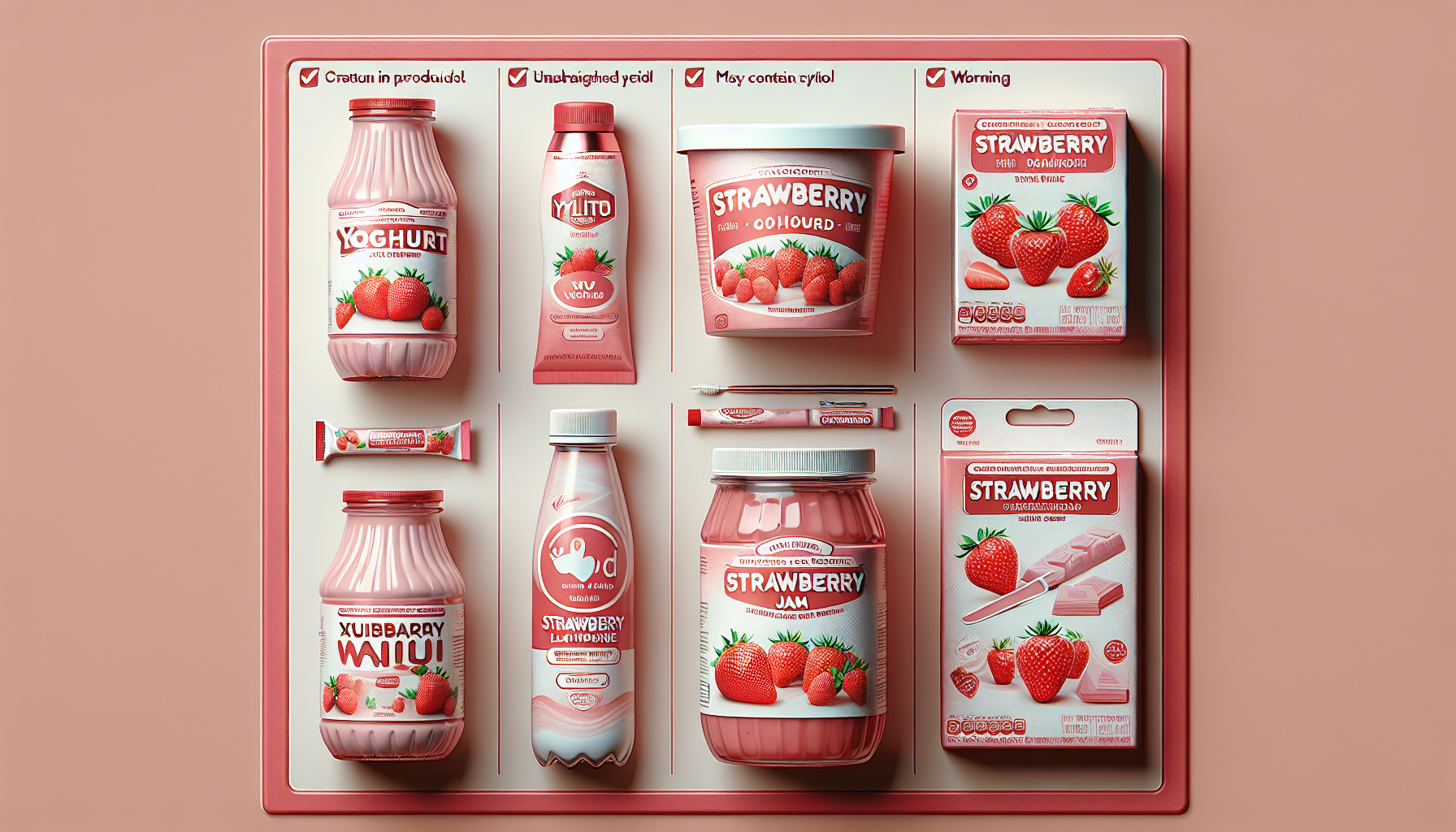
Illustration only. These are the shapes of product that need the check, not products found to contain xylitol.
Step 1: Check the Ingredient List
Search for any of these terms in the full ingredient list (not just the front of pack):
- xylitol
- birch sugar
- wood sugar
- E967
- birch-derived sweetener
- xylite
Step 2: Check the Nutrition Facts
If the ingredient list shows "sugar alcohols" in the nutrition facts, this means at least some of the sweetener is a sugar alcohol (which includes xylitol, sorbitol, erythritol, maltitol, mannitol, lactitol). Not all sugar alcohols are xylitol, but if the ingredient list does not specify which ones, treat as a potential xylitol product.
When in doubt, do not share the product with your dog.
Step 3: Front-of-Pack Red Flags
These marketing terms on the front of packaging strongly suggest xylitol or another sugar alcohol may be present:
My Dog Just Ate a Xylitol-Containing Product: Emergency Protocol
Call Poison Control Immediately
Do not wait for symptoms to appear. Hypoglycaemia can occur within 30 minutes. Call one of these numbers right now:
A consultation fee may apply. UK: contact your vet directly or the Animal Poison Line on 01202 509000.
Gather This Information Before You Call
- Your dog's weight in kg or lb
- Name and brand of the product consumed
- Approximate quantity consumed (how much of the product, or how many pieces)
- Time of ingestion (or your best estimate)
- Any symptoms already present
Do NOT Induce Vomiting Without Instruction
Xylitol is absorbed rapidly. If hypoglycaemia is already in progress, inducing vomiting can cause further complications. The poison control vet will advise whether emesis is indicated based on the time of ingestion and the dose.
Transport to an Emergency Vet
If the ingested dose is at or above the hypoglycaemia threshold, immediate veterinary care is required. Treatment typically involves IV dextrose infusion to correct blood glucose, liver enzyme monitoring over 24-72 hours, and supportive care. Do not attempt to manage xylitol poisoning at home.
Symptom Timeline
| Timeframe | Symptoms to Watch For | What's Happening |
|---|---|---|
| 0-30 min | Vomiting, apparent disorientation, lethargy | Early insulin surge, blood glucose beginning to fall |
| 30-60 min | Weakness, stumbling, tremors, collapse | Severe hypoglycaemia in progress |
| 1-4 hrs | Seizures, loss of consciousness | Extreme hypoglycaemia, possible brain glucose deprivation |
| 12-72 hrs | Jaundice, prolonged bleeding, weakness | Hepatotoxicity (liver damage) at higher doses |
Prevention: Making Your Home Xylitol-Safe for Dogs
Handbag and Pocket Discipline
Gum is the most common cause of dog xylitol poisoning in veterinary practice. Keep handbags, backpacks, and jacket pockets inaccessible to dogs. Guests should be reminded to keep bags off the floor in dog-containing homes.
Bathroom and Medicine Cabinet
Toothpaste, mouthwash and dental floss should be in closed cabinets. Dogs can chew through a toothpaste tube. Toothpaste and mouthwash are both on the FDA's list of product categories that contain xylitol, and children's flavours are the most palatable to a dog, so treat the whole shelf as out of reach rather than checking tube by tube.
Pantry Organisation
Keep any sugar-free, keto, diabetic-friendly, or 'light' products on high shelves or in closed cupboards. Never assume a dog-proofed kitchen is fully safe - a counter-surfing Labrador can reach surprisingly high.
Know Your Dog Food Label
Manufacturers update formulations without announcing it. If you regularly share human food products with your dog, re-check the ingredient list every few months. What was xylitol-free last year may not be this year.
Xylitol in Other Fruit-Flavoured Products
Xylitol appears in flavoured variants of many fruit categories. Our cluster sites cover related risks:
Applesauce and Xylitol
candogseatapples.com/applesauce - why the "no sugar added" jars are the ones to check the panel on.
Grape Products and Xylitol
candogseatgrapes.com/variants - grape jam, grape juice, sugar-free grape products.
Watermelon Flavoured Water
candogseatwatermelon.com/preparation - flavoured water and drink mix xylitol risks.
Resources and References
- US Food and Drug Administration, "Paws Off Xylitol; It's Dangerous for Dogs": fda.gov - the product categories where xylitol is found, and the label-check instruction. Content current as of 17 December 2025.
- MSD Veterinary Manual, "Xylitol Toxicosis in Dogs": msdvetmanual.com - the source of the 100 mg/kg and 500 mg/kg dose thresholds used by the calculator on this page. Published as the Merck Veterinary Manual in the US.
- American College of Veterinary Pharmacists, xylitol entry: vetmeds.org - independent confirmation of both thresholds, and the only published per-product quantity we use: gums usually contain 300 - 2000 mg of xylitol per piece.
- Dunayer EK, Gwaltney-Brant SM. Acute hepatic failure and coagulopathy associated with xylitol ingestion in eight dogs. J Am Vet Med Assoc. 2006;229(7):1113-1117. PubMed - The case series that first described hepatic failure after xylitol ingestion in dogs. Three dogs were euthanised, two died.
- Schmid RD, Hovda LR. Acute Hepatic Failure in a Dog after Xylitol Ingestion. J Med Toxicol. 2016;12(2):201-205. PubMed - A 4.95 kg Chihuahua ate 224 g of granulated xylitol, a dose of 45 g/kg. Hypoglycaemia within 1 to 2 hours, raised liver values within 12 hours, coagulopathy inside 24 hours. The dog survived, and this is the highest published xylitol dose a dog has survived.
- Murphy LA, Dunayer EK. Xylitol Toxicosis in Dogs: An Update. Vet Clin North Am Small Anim Pract. 2018;48(6):985-990. PubMed - Current veterinary review of xylitol toxicosis in dogs.
- Pet Poison Helpline, "Xylitol Poisoning in Dogs": petpoisonhelpline.com - "Typically, the dose needed to cause poisoning is at least 0.05 grams per pound of body weight (0.1 grams per kilogram of body weight)." 24/7 helpline on (855) 764-7661.
- ASPCA Animal Poison Control: aspca.org/pet-care/animal-poison-control - 24/7 helpline on (888) 426-4435
- VCA Animal Hospitals, Xylitol Poisoning in Dogs: vcahospitals.com - consumer guidance on the mechanism, signs and treatment. It does not publish numeric dose thresholds, so we no longer cite it for them.
- Manufacturer ingredient listings: every product verdict on this page links to the panel it was read from, with the date it was checked